
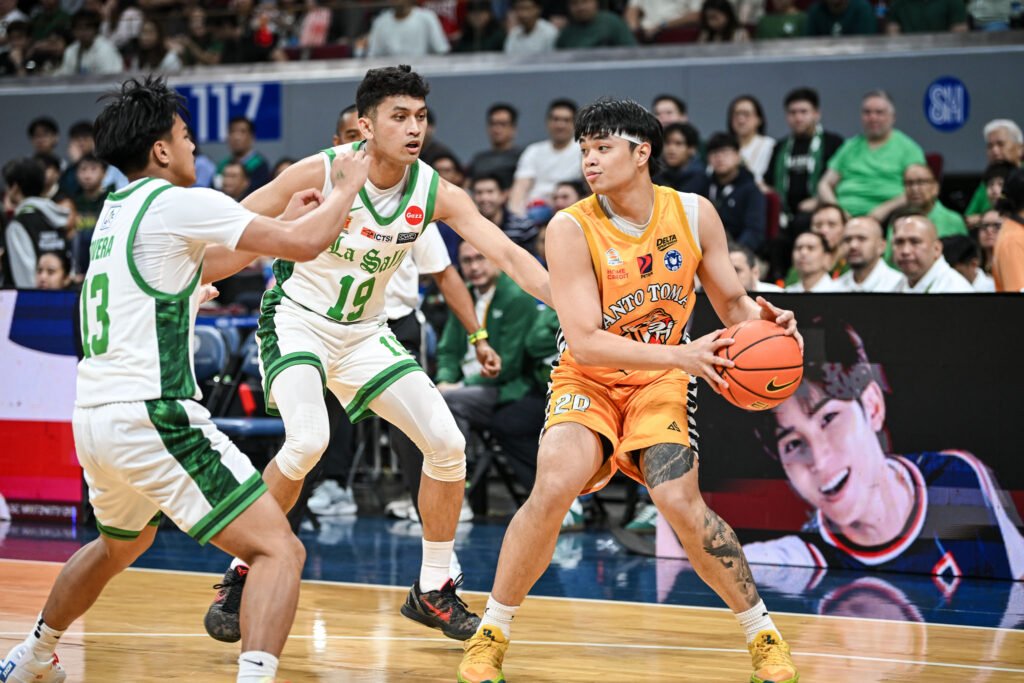
There are losses that make you angry for about 20 minutes, then curious for the next several hours.
La Salle’s loss to UST was that kind.
The initial reaction after the final buzzer was naturally disappointment. The Green Archers were within one turnover away from the possibility of a 2-0 start after a fiery comeback. The kind of early-season record that adds swagger and makes everyone feel considerably better about themselves than a 1-1.
And because the game was within reach, because La Salle had fought its way back into it, because JC Macalalag drilled that Arena-erupting three with 1:37 remaining to make it 74-73, you could almost believe an alternate ending forming in real time.
One more stop and we’re talking about a great Archers’ comeback.
One more good defensive possession, and maybe Cortez gets downhill again.
One more bounce and an inch to the left, and that twisting Jacob Cortez finger-roll drops instead of dancing off the rim.
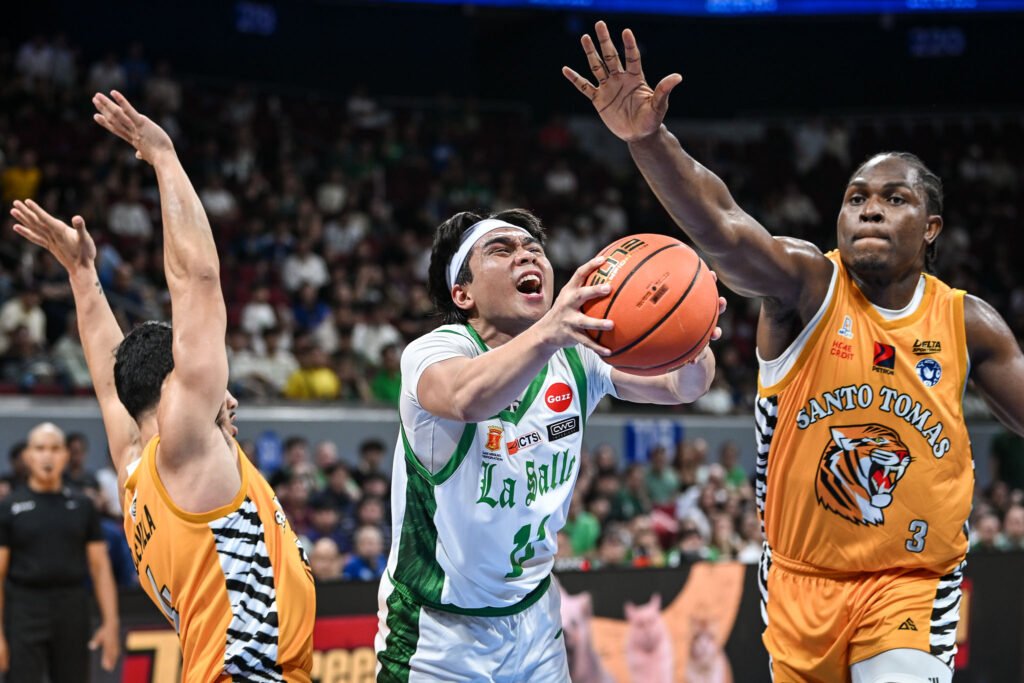
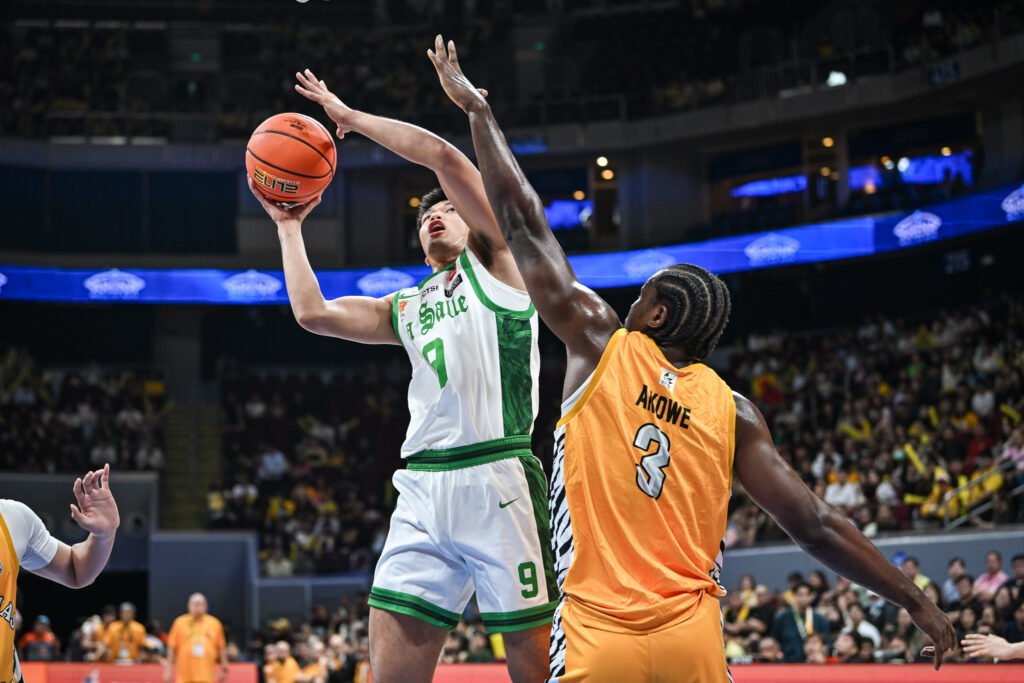
Except basketball doesn’t care about alternate endings nor feelings. The ball bounced out, Collins Akowe wolfed down the rebound, and UST walked away with a 75-80 victory.
Peeling off the maddening part of the afternoon, the game becomes considerably more interesting.
Because UST didn’t beat La Salle by some mysterious basketball sorcery. Coach Pido did not summon any voodoo thing to get the win. They found a very identifiable weakness and kept pressing on it until the Archers buckled.
The UST Tigers went after the glass ferociously. Rebounds that added more possessions.
And they did it with the enthusiasm of a kid who discovers that the refrigerator door was left open and mom just bought a cart full of chocolates.
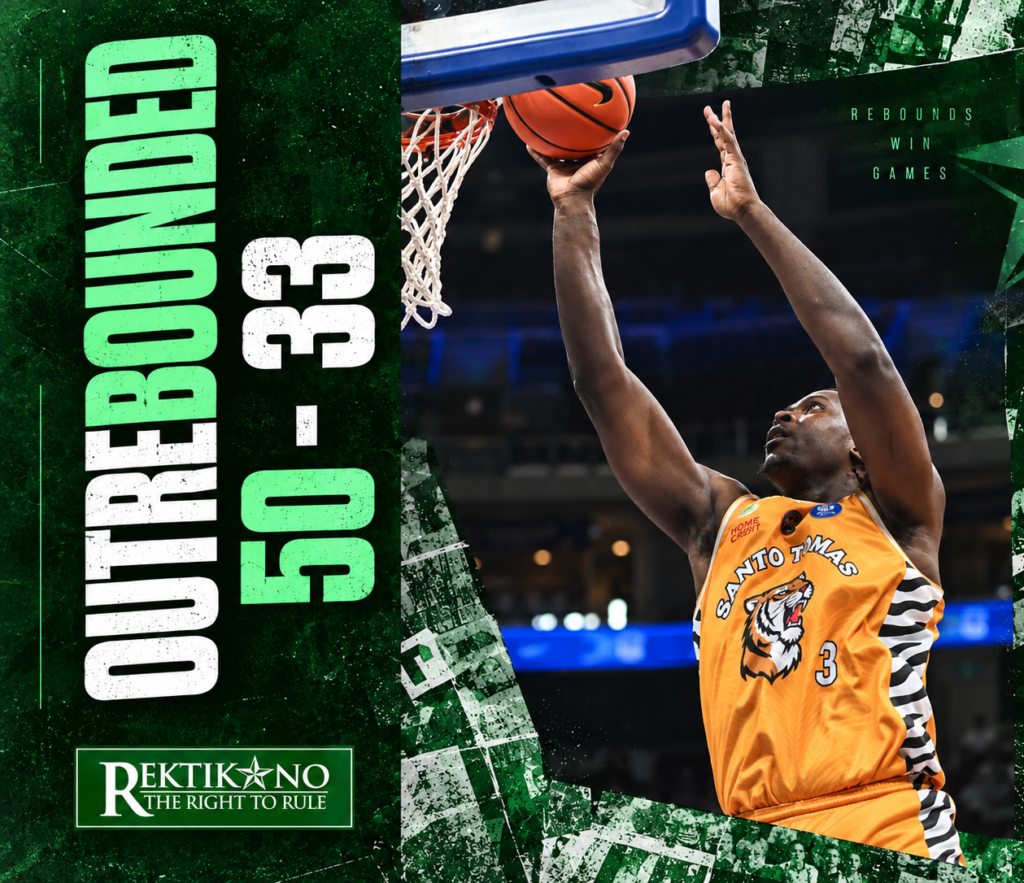
THE REBOUNDING NUMBERS ARE UGLY, BUT THE SHAPE OF THE PROBLEM IS EVEN UGLIER
UST out-muscled La Salle 50-33 off the boards. That’s a significant 17-rebound advantage, which is already bad enough, but the quarter-by-quarter progression tells you something more useful.
The Tigers won the glass 14-11 in the first, 27-18 in the second, 40-26 in the third and finished 50-33.
There wasn’t a quarter in which La Salle controlled possession.
In fact, after grabbing 11 rebounds in the opening period, the Archers collected only seven, eight and seven over the final three quarters.
Seven. Eight. Seven.
Against a UST team that was getting increasingly comfortable playing through its size and physicality, that’s an awfully small number of opportunities to end possessions.
And this is where the rebounding number stops being a statistic and starts becoming an explanation.
La Salle attempted 58 shots and missed 38 from the field. Out of the 38 misses, UST got the ball 30 times. That is a total of 30 one-and-done possessions.
That’s essentially what happened.
The interesting part is that La Salle didn’t shoot badly. Quite the opposite. The Archers went 58 percent from the two point zone. They were actually getting the ball into places near the hoop where they could make shots.
The problem was that UST was very good at making sure La Salle didn’t get a lot of those 50-50 balls.
And while UST would go back down the other end and, occasionally, miss.
Then rebound its own miss.
Then miss again.
Then rebound that one too.
At some point, defending a possession starts to feel like outrunning the Energizer Bunny.
This is why offensive rebounding matters so much. It isn’t simply about grabbing a loose ball. It’s about gaining valuable extra possessions. UST repeatedly did that and La Salle just could not stop it.

UST’S BENCH ALSO HAD A VERY GOOD AFTERNOON
Then there is the second unit, which contributed to what was essentially a completely different game from the one La Salle played against NU.
UST’s bench produced 50 points.
La Salle’s managed 21.
That isn’t a minor discrepancy. That’s a substantial 29-point chunk of the game being played by people who weren’t in the starting lineup.
Amiel Acido scored 19. Landyin Jumawan added 10. Charles Esteban had nine. Koji Buenaflor contributed five, Kirk Canete four and Kris Porter three.
Acido and Jumawan gave UST perimeter production. Buenaflor and Esteban provided solid activity around the basket. Suddenly, La Salle wasn’t simply trying to deal with UST’s starting group. It was having to solve a new problem every few minutes.
And this is where Coach Pido’s attack dog, Donovan Sevilla, deserves some attention, as he was tasked with handling the Cortez problem the entire game.
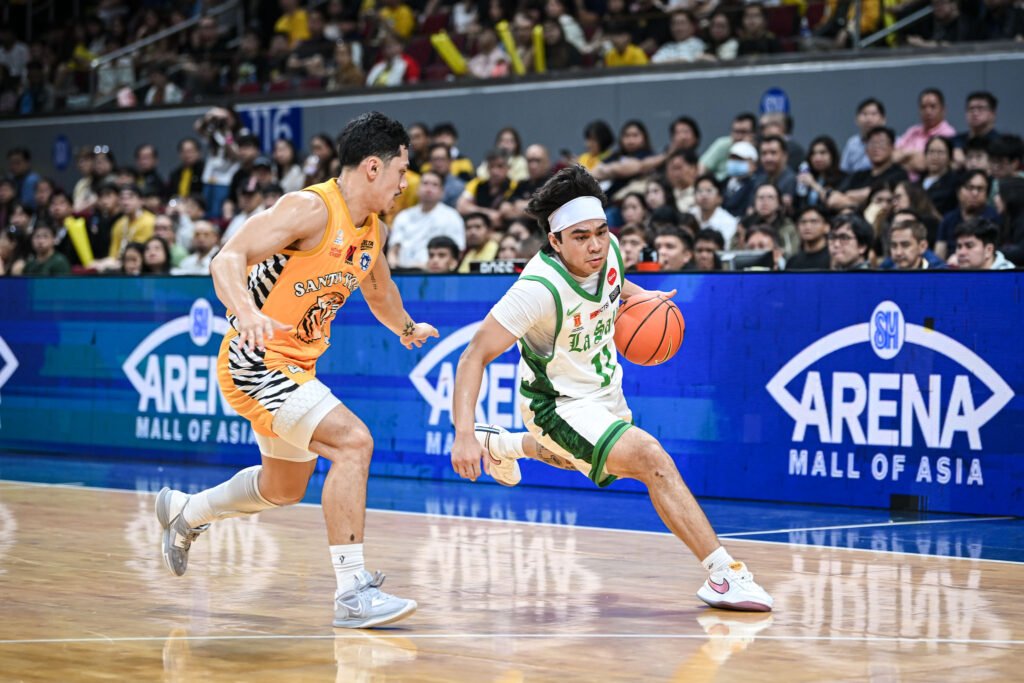
Cortez finished 3-of-13 from the field.
That’s not necessarily the entire story of Cortez’s game, but Sevilla made him work for practically everything. And while doing that, he managed four points, one rebound, and two assists himself.
Meanwhile, La Salle’s bench had JC Macalalag with 10, Doy Dungo with five, Joaquin Tovera with four and Mo Kulang with two.
Macalalag’s contribution was obviously significant, especially considering the timing of late game three, but over the course of the game, the Tigers’ relief unit played like confident starters.
That’s an important distinction because the bench isn’t supposed to reproduce the starters. It is supposed to keep the game from changing dramatically when the starters sit.
UST’s bench kept adding things.
La Salle’s bench didn’t add enough.

THAT CAN’T-HIT-THE-THREE PROBLEM
La Salle shot 4-of-23 from three.
That’s 17 percent, which is generally the sort of number that makes everyone want to blame the three-point line, the basketball, the lighting, the arena, the basketball gods and possibly the entire concept of perimeter shooting.
But the more interesting number is 58 percent from inside the arc.
The Archers have shown that they can shoot the ball well with better shot selection. No emergency threes at the twilight of the shot clock – just patient halfcourt execution fueled by quick, mindful, and purposive passing.
The gist was that the Archers just didn’t shoot enough of the shots that were falling.
When La Salle attacked inside, the offense looked fluid. Smooth. The problem was that the three-point misses tend to bounce farther and UST kept accumulating rebounds by winning the hustle on the long balls.
The shooters of Espana, meanwhile, shot almost 27 percent from three. That’s not some flamethrower performance, but it was still hotter than La Salle’s 17 percent. More importantly, the Tigers didn’t need to rely entirely on perimeter shooting because they had Akowe, Buenaflor and Esteban getting extra possessions and finding ways to flex around the basket.
So this question now arises – what La Salle does when the three-point game ain’t working?
THIS IS NOW A PATTERN, NOT YET A CRISIS
National University already offered a warning.
NU manhandled La Salle inside the paint 54-36 in the opening game and grabbed 22 offensive rebounds.
UST followed with 20 offensive rebounds.
That’s enough to put the notice on the URGENT board, but not enough sample size to declare the season broken.
The temptation after every early-season loss is to treat the latest game as a referendum on the entire roster. A team wins, and suddenly everyone has figured it out. A team loses, and suddenly, the weaknesses are permanent characteristics.
Basketball is much less predictive than that.
Teams change.
Rotations change.
Players get more comfortable.
Young guys learn where the rebounds are coming from.
Big men learn which shots they can contest without leaving themselves completely out of position.
Guards learn that “boxing out” is not something reserved for tall people.
And coaches spend an unreasonable number of hours watching the same possessions until everyone involved becomes slightly sick of seeing them.
That’s where La Salle is now.
The good news is that the film is not particularly cryptic.
UST was more physical.
UST rebounded the ball better.
UST’s bench produced.
La Salle shot the ball well overall but couldn’t convert enough from three.
And they spent too many possessions watching the other team collect its own misses.
Those are tangible things, and also very material.
WHICH IS WHY THE TWO-WEEK BREAK IS INTERESTING
If there was ever a time to have a two-week gap between games, this might be it. The next La Salle game would be on September 30, 2026 against FEU.
There is enough information from the first two games to identify some problems, but not enough games to start believing those problems are permanent. And the green big men would have another challenging 40 minutes against the Tamaraws’ primary glass cleaner – Mo Konateh.
And from 1 to Collins Akowe, how much of a problem is Mo Konateh on the boards? Konateh was the fourth leading rebounder in Season 88 and would become a problem.
Rebounding has to become a priority for La Salle because it cannot routinely give away 20-plus offensive rebounds and expect everything else to compensate.
The interior defense needs to give more resistance. The bench needs to regain the energy and production it showed against NU. The three-point shooting needs to normalize. And the team has to continue figuring out which lineups allow it to play with the physicality that UST brought into this game.
But those are the possessions that eventually decide games like that are decided by five points or less – like the UST one.
JC Macalalag’s three didn’t feel like a miracle. It felt like the natural result of a team that had refused to go away. UST just made the plays that mattered.
Coach Topex Robinson now has two games of evidence.
Against NU, the DLSU bench showed that it has the capacity to take over games and win.
Against UST, the rebounding gap became too big to ignore.
The season is still young enough that weaknesses can be corrected before they become part of the identity. The two-week break gives the coaching staff time to work on the details and gives the players time to understand that the next time somebody misses a shot, that loose ball is worth fighting over.
Now La Salle gets 14 days to do something about it.
ANIMO LA SALLE!!!
